

The Effects Of Energy, Frequency, And Vibration
“If you want to listen to the music of the mountains, you must run a diamond through the valleys.”
When a record is played, the quality of sound depends on the relationship between the needle and the groove. A diamond stylus must be light enough to oscillate freely within the groove, yet heavy enough not to jump out.
The secret to high-fidelity reproduction is perfect balance. The needle must remain in that state of balance for the entire performance, or the signal becomes distorted.
The butterfly is nature’s perfect diamond stylus. Its feet trace the grooves of creation, oscillating with lightness, yet carrying just enough weight to remain in the groove.

The Butterfly Whisperer
This book shares how butterflies carry coherence into the field, reminding us that transformation is not theory but lived experience. Through stillness, touch, and vibration, they reveal that the smallest of creatures can transmit the deepest of truths: that life is already in harmony, waiting for us to listen.

“The first gulp from the glass of natural sciences will turn you into an atheist, but at the bottom of the glass,
God is waiting for you”
Werner Heisenberg Quantum physicist


Where weight is concerned, it doesn’t matter how heavy an object is — what matters is how long you are required to hold it up. The weight itself does not change, only your ability to bear it. Even a butterfly can come to feel as heavy as a pile of books after an hour of filming. Here is how I know.
I was on top of Mariposa mountain when a storm came rolling in. The temperature dropped suddenly, and dressed only in summer shorts and a polo shirt, I thought about ending the filming session early. As I was gathering my things, a twin-tailed Pasha butterfly appeared. I thought I would take a few pictures, maybe a short video, and then head back down.
My camera can record a maximum of fifteen minutes in one session. At the end of the time, the recording stops, and I have to begin a new one. I set it to video mode, held out my hand, and the butterfly came to settle. I started the recording and waited for her to fly off. But she didn’t.
When the first session ended, I clicked the shutter release and began again.
When butterflies sense rain, they usually hide. But midway through the second session, the Pasha was still perched on my hand, even as the storm rolled closer. By then she felt as heavy as a bag of sugar. As the weather deteriorated, the other butterflies vanished, but she stayed. Another full session. Thirty minutes of video in total. I clicked the shutter release to begin a third.
Determined to see this interaction through, I held my ground. By now the camera felt like a bag of rocks. My grip was weakening, and I had to adjust my position. This is usually when butterflies take fright and fly away. I thought this might be the end. But no — she stayed. The third session ended, and the Pasha remained, as if waiting for something. I clicked the shutter again for the fourth time.
At 1 minute and 40 seconds into that final session, she began to share a vibratory signal that passed directly into me. The message came as a sequence of high-speed pulses, like an old modem connecting — long and short flurries of activity, conscious and intentional. It felt extraordinary.
On video, you will see her vibrations clearly. But what the camera cannot capture is how it felt — as though the butterfly had become a diamond stylus, transmitting vibrations straight into my body.
Visit the video page to see the end of this video for yourself.
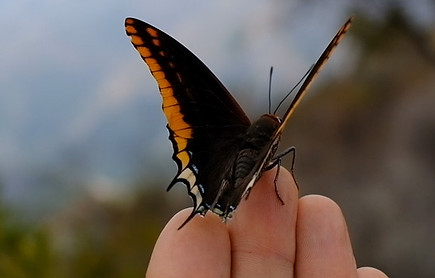
Twin tailed Pasha (Charaxes Jasius)
If my writing has brought clarity, encouragement, or a fresh perspective to your life, you’re welcome to support the continuation of this work. Every contribution helps sustain independent publishing, develop new books, and maintain bfwings.com as a home for long-form thought. Your support strengthens the foundation that allows this work to remain free, focused, and uncompromised.